– 1 cup acorn meal – 1 cup flour – 2 tbsp baking powder – ½ tsp salt – 3 tbsp sugar – 1 egg, beaten – 1 cup milk – 3 tbsp oil
1) Heat an oven to 400 degrees (F). As you wait, grease a loaf pan and sift together the dry ingredients.
2) In a separate bowl, combine the wet ingredients. Either in a stand mixer or with your arms, gradually mix in the dry ingredients until a thick batter is formed.
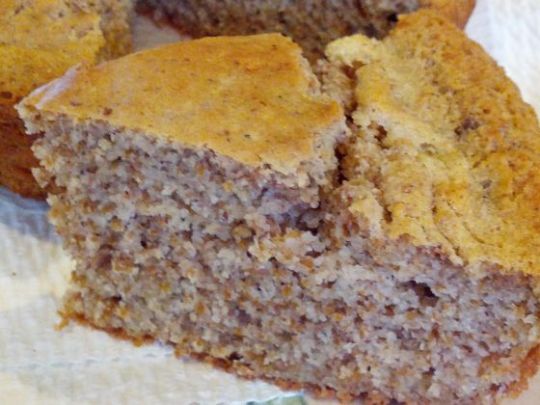
3) Pour the batter into the pan and bake for about 30 minutes!
Chef’s Note: If you can’t find acorn meal, or otherwise don’t wish to order it online, it is possible to make your own! Just be sure to harvest wisely, and to prep the acorns properly so as to avoid bitter flavors and upset stomachs! More information to follow!
Magical Ingredient!
As some know, I live on the Central Coast of California. Here, the weather is lovely and temperate year round, and the hills are perpetually deep green with the leaves of our native coast live oaks. Though the majority of our cuisine here is beef (BBQ being a bit of a staple around here) and seafood, it hadn’t always been that way. Imagine the excitement I had at a young age when I learned that those twisted and ancient branches dropped a food source year round which both the Salinan and the Chumash tribes made use of!
Today, acorns are often swept off of front porches, and especially in this area, they are usually disposed of along with the rest of the green waste. Pounds and pounds of the little nuts go to waste, but they could instead be harvested for a treat that has largely been forgotten throughout Europe and European countries, save for a couple of dishes.
Just in time for Thanksgiving, this particular bread is sweet and nutty, and ideal for a dessert, appetizer, or even a light breakfast! In addition, it’s very healthy and allows us to incorporate the magic of acorns and oak trees in ways we may otherwise overlook!
Like oak trees, acorns and humans have a long relationship. These beautiful trees grow throughout the northern hemisphere, with many different species and variations within the family. As a result, acorns can be found throughout the whole range, and where acorns can be found, humans had consumed them at some point in history. Because they are plentiful, and produced year-round, they were an easy-to-harvest food source, and were highly nutritious after some preparation.
It’s not completely clear how or why we switched over to grain, but the current running idea is that as demand for food rose with growing populations, there were occasionally conflicts over resources. Grain was simpler to carry, easier and quicker to grow, and took very little energy to harvest and prepare. When under attack, it’s a lot more difficult to dig up an oak tree and carry it away than it is to grab a handful of grain to grow.
However, oak trees never lost their significance in lore and history – the Irish Celtic writing system, called “Ogham,” is now linked to tree mythology, and features the Oak as its seventh character, “Dair.” In Irish folklore, the oak was a watcher and protector – a tree which represented nobility, stability, and strength. So much so, in fact, that it was associated with the Dagda, who was the chief of the Tuatha De Danann (the Irish Celtic gods). It was highly venerated by varying other Celtic cultures throughout Europe as well, and even by the Norse, who believed the oak tree to be a connection to the three worlds of the shaman.
One of the most famous stories involving an oak tree surrounds that of “Thor’s Oak.” It was said that a particular community of Norsemen venerated an oak as being sacred to Thor. A Catholic missionary challenged Thor, saying to stop him from cutting it down if he exists. The missionary then took an axe to the tree. A storm broke out and lightning struck the tree, destroying it. That moment, the whole community converted. Though the validity of this tale is left to some debate, it can be taken either way – did the missionary truly put the Norse gods to shame, or did Thor intentionally strike the tree to send a message?
Regardless, the fact that the tree was an oak says a lot about what was being said in the story – the royal nature of the tree, its strength, and its sacred status made it an important symbol of pagan faith in Europe.
In North America, the oak was still an important symbol and useful food source. In one Sioux legend, for example, a hunter who spurns the advances of an enchantress wakes one night to find an oak growing out of his belly, and is trapped in the rapidly growing oak tree until the spirit ruling over thunder and lightning frees him. This provides the oak with a link to magic, as well, which is another feature we see in much of European lore.
Hopping back to Europe, in fact, the oak tree has some association with the faerie -an inherently magical concept. And in some variations of the Arthurian legends, Merlin meets his downfall at the hands of Morgan le Fay, who imprisons him in an ancient oak tree. (Note that this is only in some variations… other variations include a stone tomb as in the Lancelot-Grail and in Le Morte d’Arthur.)
In today’s witchcraft, the oak tree has a long history, but the acorns have their own unique purposes as well. Given that they are plentiful, they are associated with wealth and prosperity. Furthermore, their connection to the oak tree connects them to wisdom and protection.
Place acorns on an altar to attract faerie or to draw luck and prosperity to your home, or simply as an excellent way to help ground your spells. When placed in a window, acorns help ward against negativity and harmful spirits. String acorns on a cord as a necklace or charm to ward against lies and deceit, and to draw wealth and luck.
Holding an acorn, one can also cleanse by using it to help channel away negativity and stagnant energy. Acorns can also be used as a symbol for male fertility, and therefore can be used in charms, bags, or other spells to enhance fertility and promote masculinity in spells where needed.
In kitchen witchery, the acorn is often overlooked for the very reason that few ever consider it to be a food item anymore (I should note, though, that acorns are still consumed in Korea and that it’s possible to acquire acorn soba noodles online) and because it takes some work to ensure that the acorns are leached of all their toxins. However, all of the aforementioned properties can be incorporated into the breads, pancakes, cakes, et cetera that can be made with acorn flour.
Harvesting and Preparing Acorns
If you plan on harvesting and cooking with acorns, be sure to gather at least a gallon of acorns from a safe and pesticide-free location. Take these and place them into a bucket, and pour water into the bucket. Any acorns that float should be removed, as they may contain oak weevils and other parasites.
Bring a large pot of water to a rolling boil. Transfer the acorns into the boiling water for about thirty seconds, then immediately remove them. This will help make shelling them easier – using a nutcracker, or hammer and towel, crack open the acorns.
Transfer all of the acorns onto a sheet tray in an even layer, and bake them in an oven for about 20 minutes to a half hour at 250 degrees (F) to dry them out. The nuts themselves will shrink and separate from the shells and inner membranes. From there, you can easily remove the nut meats and save them for preparation.
The next step is incredibly important – it will remove the bitter flavors from the acorns, and will remove all of the tannins which can cause stomach upsets. Place the acorns into a pot, fill it with water, and place over medium heat. Allow the acorns to lightly boil for an hour, then strain in a colander. Repeat this as many times as it takes for the water to come out clear and the acorns no longer have bitter flavor.
At this point, the acorns can be mashed up and dried for grinding into meal, grits, and flour!
These little nuts have been used as a food source for thousands of years, and though it takes a lot of work to prepare them for safe consumption, they are particularly healthy and quite delicious! The history and relationship between oaks and humans is extensive, and filled with magic. So when it comes time for the Samhain season, the Thanksgiving season, or even for a healthy snack, see what kinds of benefits the magic of acorns can bring to you!

 Moonglade Poetess